
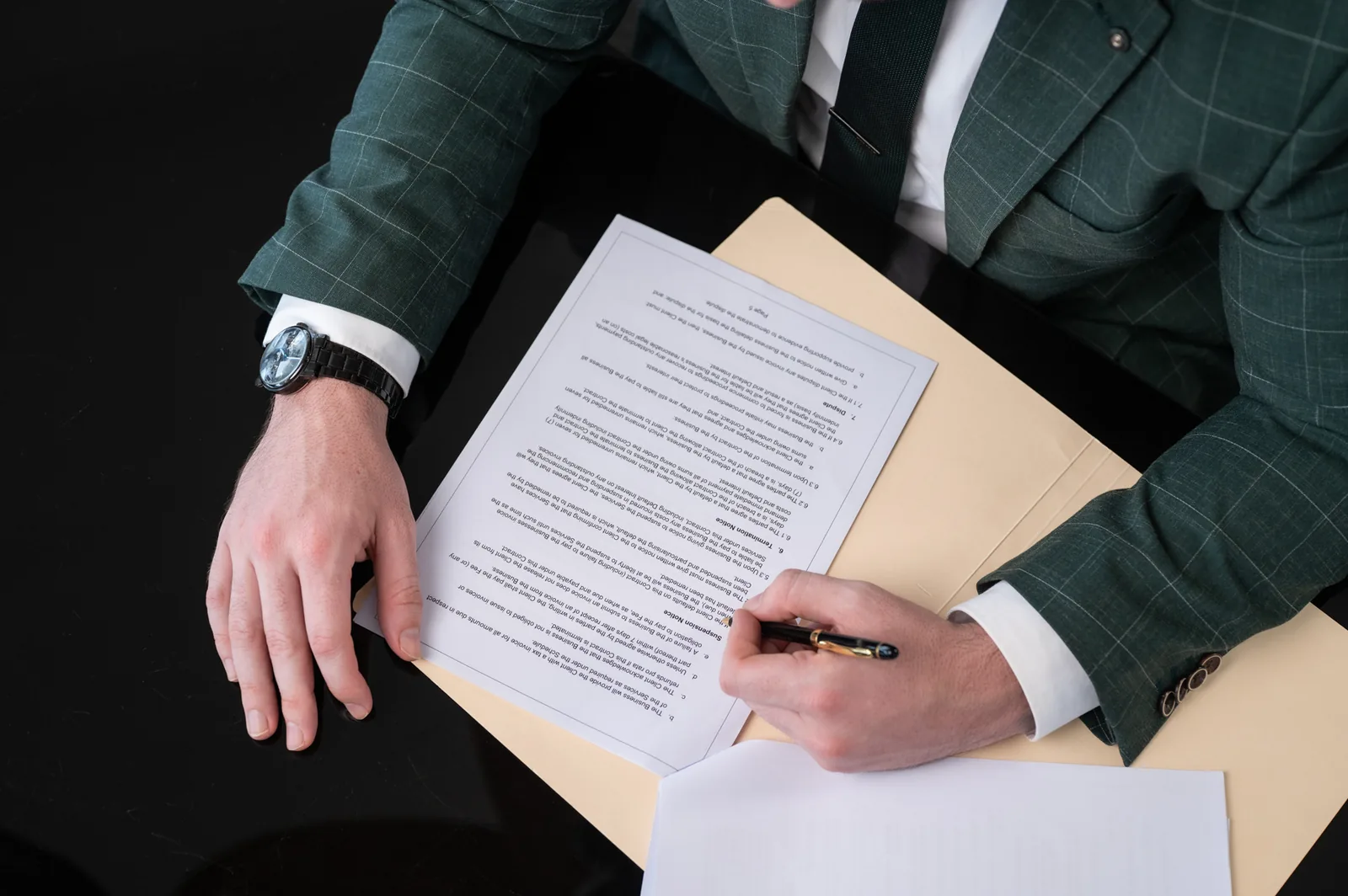

Hands and pen over a legal document in a manila folder
Residential Building Contract Review

Your building contract is negotiable, right up until you sign it

We review residential building contracts for Queensland homeowners: clause by clause, against the QBCC Act, and back to you with the amendments to put to your builder in writing.

Master Builders, HIA and QBCC contractsRead against the QBCC ActQuoted in writing before we start

Start with the Fast-Track Assessment

Four questions, about a minute. It tells us what kind of review your contract needs, and it tells you whether it still needs one.

Is your building contract legally sound? Take the Fast-Track Assessment

Who are we speaking to?

So we can send the assessment result back to the right person.

01 / 04

Or call (07) 5370 8759 and speak to our experts directly.

The whole of your leverage sits in the days before you sign

A building contract is not a formality at the end of choosing a builder. It is the only document that will decide what happens on every bad day of the next twelve months, and there is exactly one moment when you can still change it.

Before you sign

A proposal

Every clause is something being asked of you. A term you will not accept can be struck out, capped or replaced, and it costs a conversation. Builders amend contracts routinely. They just do not offer to.

After you sign

The law between you

The same clause is now binding, and changing it needs your builder to agree to something they have already won. The venue stops being the kitchen table and starts being QCAT or the QBCC.

Odyssey Legal sitting down with a client over documents
Odyssey Legal

If you have already signed, the review still has work to do. It changes shape rather than stopping: we read the contract for what you can enforce, what to put in writing now, and where the timeframes sit. If the relationship has already broken down, that is a dispute, and it is dealt with on our building and construction disputes page rather than this one.

What the review covers

Five passes over one document, and a written list of recommendations at the end of them.

The particulars

The starting point, and the part most people skim. We check the particularised information is correct and matches what you actually agreed: that the deposit is within the cap the QBCC Act sets, who carries the cost of obtaining building approvals, the anticipated start date, the rate of liquidated damages, and whether the payment schedule is proportionate rather than front loaded with large sums early and very little left at the end.

Deposit cap, approvals, start date, liquidated damages, payment schedule

The general conditions

The clauses that decide what happens on every ordinary day of the build, and on the bad ones. We read them in full and tell you how each one operates in practice rather than what it says on its face. The eight questions we answer are set out in the next section.

Clauses 4 to 19, read in full

Extenuating circumstances

The situations the contract is least likely to have explained to you, and the ones with the most money attached. What happens if your builder goes into liquidation partway through, what a liquidator can claim from you for work already done, and what you are entitled to if the contract ends early or the work comes back defective.

Insolvency, termination, defective work

Your specific concerns

Special conditions and annexures are where a standard form contract stops being standard, and they are drafted by the builder's side. If there is a clause that has been worrying you, or a term the builder has added and asked you not to worry about, bring it to us by name and we will answer it directly.

Annexures, amendments, anything a builder has asked you to accept

What comes back to you

A written list of recommendations against your contract, not a summary of it. Proposed amendments where a clause should be changed, the terms worth pushing back on and the ones that are ordinary, and the points to raise with your builder before you sign. That list is the deliverable, and it is what you take into the conversation.

A marked contract and the amendments to put to your builder

The eight questions we answer about the general conditions

These are the clauses the build actually runs on. Our analysis of them covers, without limitation:

(a)When works are to be commenced, and what happens if there is a delay in commencement
(b)What clauses increase or decrease the contract price, and how each clause operates
(c)How variations may arise, and your rights in response to a variation request
(d)How extensions of time arise, and your rights in response to an extension request
(e)What happens if the builder breaches the contract
(f)What happens if a dispute arises
(g)The practical completion process, and what you are agreeing to when you sign it off
(h)Any special conditions that are incorporated into the contract

And the four that have nothing to do with the building work

Extenuating circumstances. The parts of the contract nobody expects to need, which are reliably the parts with the most money attached.

(a)

Your builder goes into liquidation

Partway through a build, with your deposit and progress payments already made and the site half finished. What the contract lets you do next is decided before you sign it, not after.

(b)

A liquidator makes a claim on you

For works performed or materials purchased by the builder before the collapse. Whether that claim reaches you at all depends on how the contract handles title in materials and payment on account.

(c)

You need to terminate

Your options and rights if you end the contract, and what is payable by whom when you do. Terminating without the right to do it is itself a breach, which is the expensive way to learn this clause.

(d)

The works are defective

What the contract gives you on top of the statutory warranties, how the defects liability period interacts with them, and what you have to do to preserve the claim.

Odyssey Legal

A builder collapsing partway through a build is the scenario that turns a contract review from a precaution into the only thing standing between you and an unfinished house you have already paid most of. The clauses that decide it are clauses 22 to 25, and they are read against the Queensland Building and Construction Commission Act 1991.

Why Odyssey Legal

Odyssey Legal's principal in hi-vis holding a hard hat

The reviewer is the litigator

The same practice runs building and construction disputes through QCAT, the QBCC and adjudication. The clauses in your contract are read by people who have had to argue them afterwards, which is a different reading from a first pass by someone who never will.

A marked contract, not a letter about it

You get the amendments to ask for, in writing, against the clause numbers in your own document. Something you can send to your builder rather than something you have to translate first.

Queensland contracts, Queensland law

Master Builders, HIA and QBCC residential forms, read against the QBCC Act, the schedule 1B requirements and the statutory warranties that apply here and nowhere else.

Quoted before anything starts

The scope and the cost of the review are put to you in writing before any work begins, so the review never becomes its own surprise.

Fast-Track Assessment

Send us the contract before you send it back

Four questions, about a minute. It tells us what kind of review your contract needs, and it tells you whether it still needs one.

If you are on a deadline from your builder, say so in the last question. Or email info@odysseylegal.com.au with the contract attached, or call (07) 5370 8759 if you would rather talk it through first.

Frequently asked questions

Do conveyancers review building contracts?

Generally not, and it is worth being clear about why. A conveyancer acts on the transfer of the land: title, searches, settlement, the contract of sale. A residential building contract is a construction contract, governed by the QBCC Act and its statutory warranties, and the risk in it sits in variations, extensions of time, progress claims and termination rather than in title.

Plenty of people buy land and build on it with a conveyancer on the first contract and nobody on the second. The second one is the one that runs for a year and carries the money.

Do lawyers deal with building contracts in Queensland?

Yes, and for residential work there is a body of Queensland-specific law that applies whether or not anyone reads it. The Queensland Building and Construction Commission Act 1991 sets deposit limits, requires particular documents to be given to the owner, and implies statutory warranties into the contract that the parties cannot simply write out.

Can I still negotiate after I have signed?

Only if the builder agrees, and once they hold a signed contract they have no particular reason to. A signed contract can be varied by agreement in writing, so it is not impossible, but you are asking rather than negotiating.

That is the difference the page opens with, and it is why the assessment asks whether you have signed. If you have, the review changes shape: we read the contract for what you can enforce and what you need to be careful of from here, rather than for what to change.

Can I terminate a building contract if issues arise?

Termination of a building contract is possible under the terms of the contract, under common law, or for acceptance of repudiation if a substantial breach of the contract occurs. However, not all breaches will give rise to the right to terminate the contract. If the contract is unlawfully terminated, the other party could seek damages. It is therefore crucial to seek legal advice before terminating a contract.

What is a statutory warranty?

Statutory warranties are legal obligations under the Queensland Building and Construction Commission Act 1991 (and other legislation) imposed on builders to ensure work meets certain standards and incorporated into building contracts.

They apply on top of whatever the contract says, which is why a contract that appears to limit the builder's obligations may not do what it looks like it does.

Can I claim liquidated damages for delays?

Subject to the building contract, yes, it is possible to claim liquidated damages (or general damages) for delays beyond the practical completion date.

The rate is in the particulars, and it is sometimes left at a nominal figure or struck out entirely before signing. That is one of the first things the review checks.

What if my builder will not change anything?

That is a real answer and it is useful. You then know exactly which risks you are accepting and what they are likely to cost, instead of finding out at the first variation. Some of our recommendations are things to ask for, and some are things to plan around.

Call (07) 5370 8759
Export Design
Download files for your developer
General
WordPress Builders